

A – Z Coaching and Mentoring – This week’s extract highlights Kolb’s learning cycle, a useful model that focuses in on the learner’s internal cognitive processes.
Don’t forget if you have a special request for a definition of a coaching term or principle, just let us know! Perfect for anyone studying for an ILM Coaching & Mentoring qualification, or as a refresher for experienced coaches.
Kk
Kolb’s Learning Cycle (1984) shows learning as a continuous process involving 4 stages:
- Concrete experience (feeling – a new experience or situation is encountered, or a reinterpretation of existing experience)
- Reflective observation (watching – of particular importance are any inconsistencies between experience and understanding)
- Forming abstract concepts (thinking – gives rise to a new idea, or a modification of an existing abstract concept (the person has learned from their experience)
- Testing (experimentation) in new situations (doing) – the learner applies their idea(s) to the world around them to see what happens.
“Learning is the process whereby knowledge is created through the transformation of experience” (Kolb, 1984)
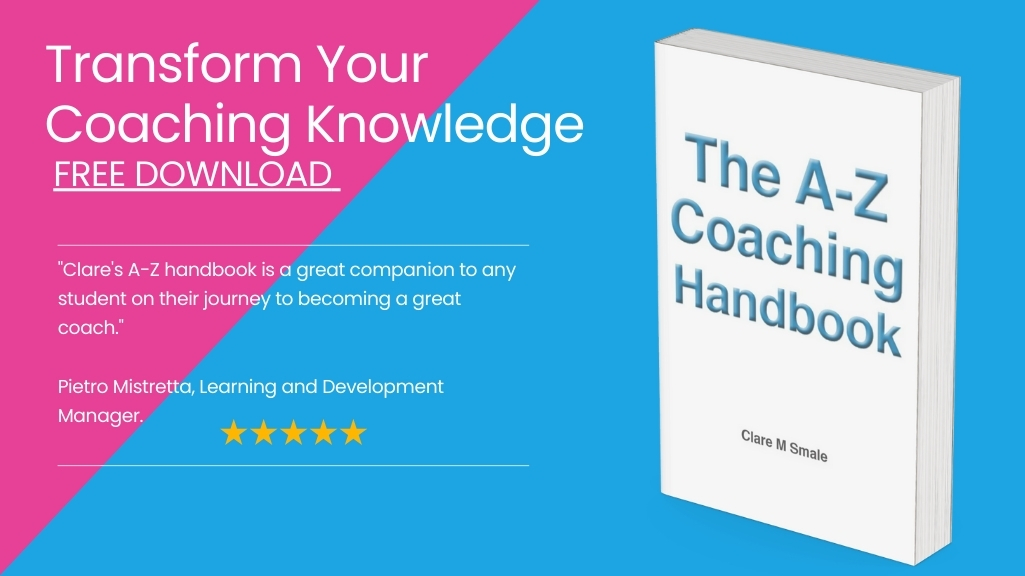
Taken from the A-Z Coaching Handbook by Clare Smale where you will find a comprehensive A-Z, plus a full list of references.
Contact us for your copy or order through our website. Click here to find out more about ILM Qualifications.